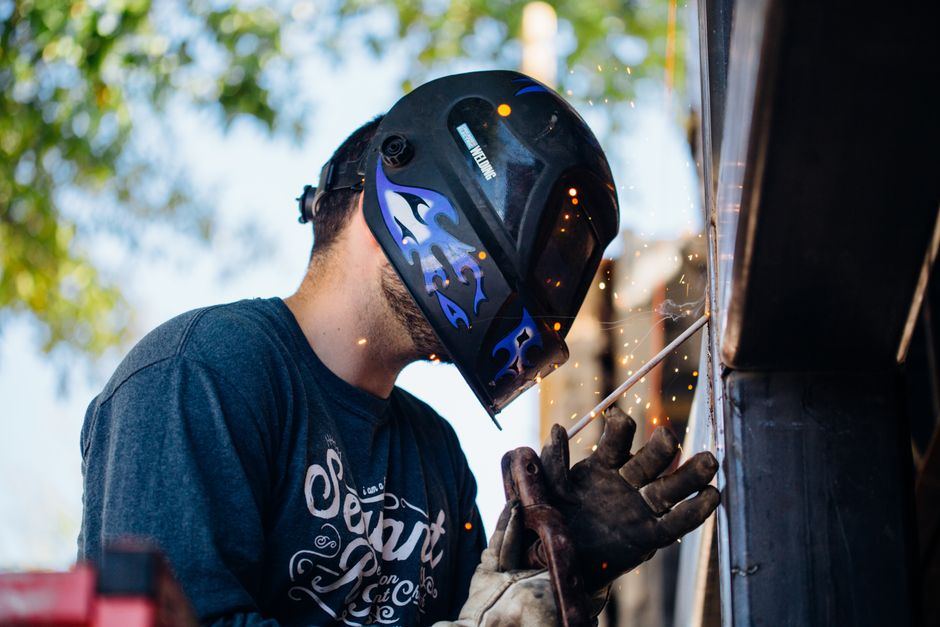
welding helmet buying guide

Welding helmets and shop gear, compared for real fabricators

Welding helmets that keep up with real shop work

We compare the top-reviewed auto-darkening welding helmets of 2026 on optical clarity, reaction speed, shade range, and comfort, so you can strike an arc without guessing whether the lens will keep up.

Compare the top welding helmets
⚡ Limited-time perk

Free two-day delivery on your pick

Get your pick delivered fast -- try Amazon Prime free for 30 days.

Sponsored link -- we may earn a fee if you sign up. No extra cost to you.

Quick answer: Our top pick for welding helmet is the Lincoln Electric VIKING 3350 Auto-Darkening Welding Helmet (Best Overall). If you're looking for best for professionals, the Miller Digital Elite Auto-Darkening Welding Helmet is a strong alternative.

The one piece of gear you can't weld without

Reviewed by the Weldhaven team · last updated 2026-08-27

A welding helmet is the one tool in the shop that has zero margin for error -- a slow or dim auto-darkening lens means flinching mid-bead, which shows up as inconsistent welds and, over years of exposure, real eye strain. Auto-darkening filters (ADFs) have made fixed-shade flip helmets largely obsolete for anyone welding more than occasionally, but the ADFs themselves vary widely in reaction speed, optical clarity, and how well they handle low-amperage TIG work.

Optical clarity is rated on a 1/1/1/1 scale across four factors -- the lower each number, the clearer and more true-to-color the view. Budget helmets often cut costs here first, which is fine for occasional MIG or stick work but starts to matter once you're doing detailed TIG welds or spending full shifts behind the lens. Shade range matters too: a wider range (roughly 4-13) covers everything from light-gauge TIG to heavy stick and plasma work without swapping helmets.

Power source is a smaller but real consideration -- pure solar-powered ADFs never need a battery swap but can lag in low light, while solar-lithium hybrids stay reliable in dim shop corners at the cost of an occasional recharge or battery change. Weight and headgear design also add up over an 8-hour shift more than most buyers expect on the showroom floor.

A helmet protects you, but it's only the first piece of a working setup. Once it's picked out, the next decisions are usually the welding machine itself, a way to cut and prep metal cleanly, and a stable table to work on -- we cover all three below.

Optical clarity (1/1/1/1 rating)

Look for a 1/1/1/1 optical clarity rating, the best available -- it means minimal distortion, diffusion, variation in light transmission, and color deviation. Budget helmets are often 1/2/2/3 or similar, which is noticeably hazier and more fatiguing over a full shift.

Reaction speed and shade range

A fast ADF switches in 1/20,000 to 1/30,000 of a second -- fast enough that your eyes never register the flash. A wide shade range (roughly 4-13) covers everything from light TIG to heavy stick and plasma cutting without needing a second helmet.

Power source

Solar-only ADFs are maintenance-free but can lag in dim shop lighting; solar-lithium hybrids stay consistently responsive but need an occasional battery swap or recharge. For a home garage with good lighting, solar-only is usually fine.

Weight and headgear fit

A helmet that feels fine for five minutes in a store can feel very different after two hours of overhead welding. Pivoting or ratchet-adjustable headgear that distributes weight across the forehead, rather than resting it all on the top of the head, makes the biggest difference for all-day comfort.

Building out the rest of the station

A helmet protects your eyes and face, but it doesn't weld, cut, or hold your workpiece steady. Most home fabricators end up needing a MIG welder or multi-process machine sized to their material thickness, a plasma cutter for clean metal prep, and a dedicated welding table -- see our guides to each below.

Product Best For Price Rating
Lincoln Electric VIKING 3350 Auto-Darkening Welding Helmet Best Overall $250 - $300 4.8/5
Miller Digital Elite Auto-Darkening Welding Helmet Best for Professionals $300 - $360 4.8/5
ESAB Sentinel A50 Welding Helmet Best Touchscreen Controls $300 - $340 4.7/5
Antra AH6-260-0000 Auto-Darkening Welding Helmet Best Budget $50 - $70 4.5/5
YESWELDER True Color Large View Welding Helmet (LYG-M800H) Best for Beginners $70 - $100 4.4/5
Best Overall

Lincoln Electric VIKING 3350 Auto-Darkening Welding Helmet

4.8

Lincoln's flagship helmet, built around 4C Lens Technology for 1/1/1/1 optical clarity and the largest viewing area in its class, with a pivoting headgear design for comfort over long shifts.

  • 1/1/1/1 optical clarity with minimal green tint
  • Largest viewing area in its class
  • Pivot-style headgear built for comfort over long sessions
  • 3-year warranty on the auto-darkening lens
  • Premium price for a solar-lithium hybrid helmet
  • Replacement lenses and parts cost more than budget alternatives
Best for Professionals

Miller Digital Elite Auto-Darkening Welding Helmet

4.8

A professional-grade helmet with ClearLight lens technology, a 9.2 sq. in. viewing screen, and four independent arc sensors that self-adjust sensitivity to changing shop conditions.

  • 9.2 sq. in. viewing screen, one of the widest available
  • 4 arc sensors with AutoSense self-adjusting sensitivity
  • ClearLight lens reduces eye strain on long shifts
  • Well-regarded warranty and parts support
  • Heavier than some competing helmets
  • Among the pricier options in this comparison
Best Touchscreen Controls

ESAB Sentinel A50 Welding Helmet

4.7

A fully digital helmet with a color touchscreen interface, 8 memory settings, and a low-amperage TIG range down to 2 amps, aimed at welders who move between processes often.

  • Touchscreen controls with 8 saveable memory settings
  • 9.27 sq. in. viewing area
  • Low-amperage TIG range down to 2A
  • Infinitely-adjustable HALO headgear
  • Touchscreen is harder to operate with thick gloves on
  • Rechargeable battery needs occasional charging, unlike pure-solar helmets
Best Budget

Antra AH6-260-0000 Auto-Darkening Welding Helmet

4.5

A solar-lithium dual-power helmet with a wide 4/5-9/9-13 shade range and 4 arc sensors, built for TIG, MIG/MAG, stick, and plasma work at a fraction of the cost of premium brands.

  • Very low price for a wide-shade-range auto-darkening helmet
  • Solar-lithium dual power for reliable low-light performance
  • Includes 6+1 extra lens covers
  • Handles TIG, MIG/MAG, stick, and plasma grinding
  • Optical clarity noticeably behind premium 1/1/1/1-rated helmets
  • Grinding mode is less refined than higher-end models
Best for Beginners

YESWELDER True Color Large View Welding Helmet (LYG-M800H)

4.4

A budget-friendly helmet with 1/1/1/1 true-color optical clarity, a large 3.93" x 3.66" viewing area, and blue-light-blocking lens tech usually reserved for pricier helmets.

  • 1/1/1/1 true-color optical clarity at a beginner-friendly price
  • Large viewing area for the price point
  • 4 arc sensors with wide 3/5-9/9-13 shade range
  • Blue-light-blocking lens reduces eye fatigue
  • Headgear build quality isn't on par with major brands
  • Smaller company means a thinner support/warranty network

Which one should you get?

Just starting out with a home MIG welder

Go with the YESWELDER LYG-M800H. It gives you true-color 1/1/1/1 optical clarity, usually reserved for pricier helmets, at a price that won't hurt if you're still learning technique.

Welding daily in a professional or fabrication shop

Choose the Miller Digital Elite or Lincoln VIKING 3350. Both are built for full-shift comfort and hold up to years of heavy daily use, which matters more than the up-front price difference over time.

Doing detailed low-amperage TIG work

Pick the ESAB Sentinel A50. Its TIG range goes down to 2 amps, well below what most other helmets on this list support, which matters for thin-gauge and precision TIG welds.